

How Is a DPF Actually Cleaned? Methods, Chemicals and What to Expect
The short answer
“Cleaning a DPF” can mean several different things — regeneration (burning off soot), in-car chemical treatment, or professional on-car and off-car cleaning that physically removes both soot and ash. Soot can be burned away; ash can’t, and it needs a proper cleaning process to shift. There’s no single magic chemical that dissolves a blockage — serious DPF cleaning is a controlled process, not a bottle.
When people talk about “getting the DPF cleaned,” they often mean completely different things — and some of those methods fix a problem the others can’t touch. If you understand what’s actually inside a blocked filter and which cleaning method deals with it, you’ll know whether your car needs a good drive, a bottle of additive, or a professional clean. Here’s how DPF cleaning really works, in plain English.
First, what’s actually blocking the filter?
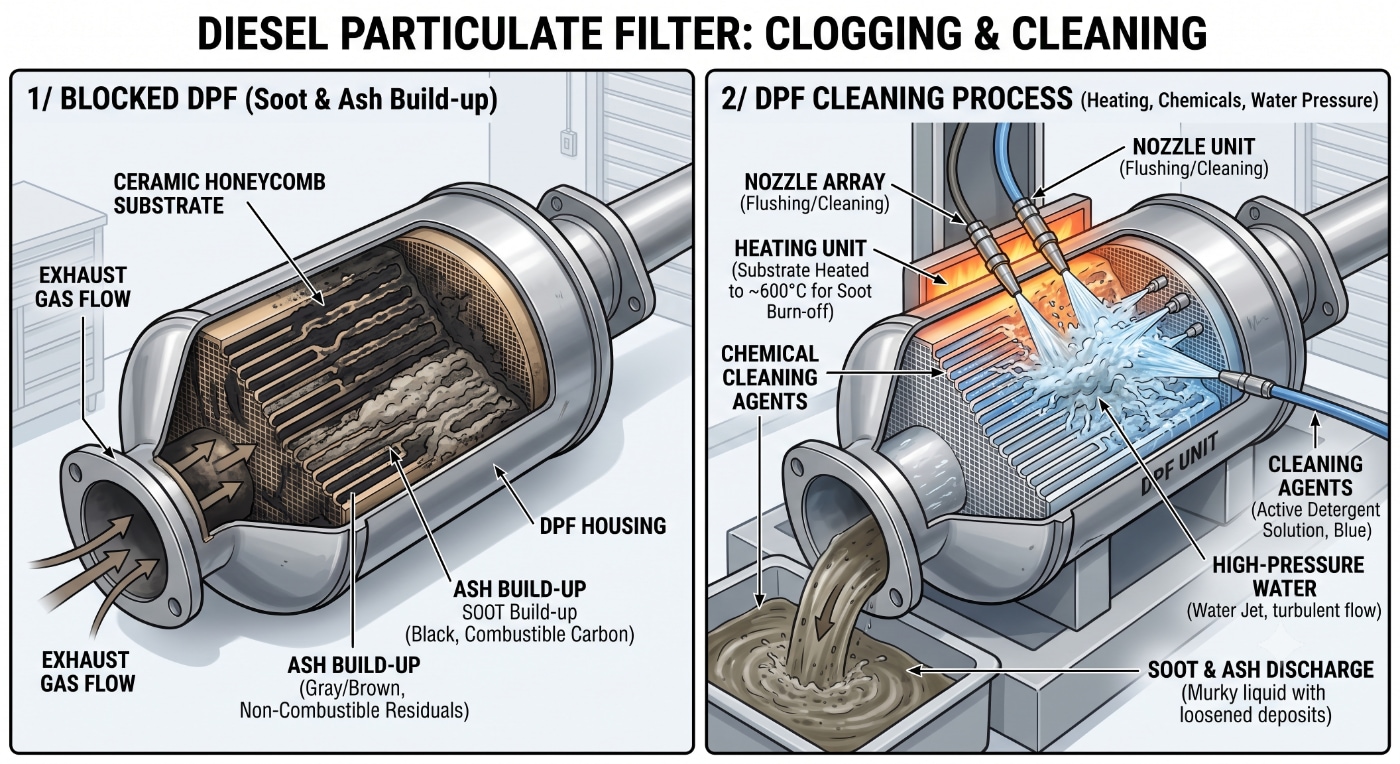
A DPF traps two very different materials, and they don’t respond to the same treatment. Soot is the combustible carbon your engine produces during normal running — the filter is designed to burn it off. Ash is the non-combustible mineral residue left behind over time, mostly from engine oil additives and normal wear; it doesn’t burn off and slowly fills the filter for its whole life. That single distinction decides which cleaning method you need.
We explain the soot-versus-ash difference in full — and how the filter tries to clean itself — in our guide to DPF regeneration. Here we’re focused on what happens when regeneration alone isn’t enough and the filter needs actual cleaning.
The methods of cleaning a DPF
1. Regeneration — the filter’s own self-clean
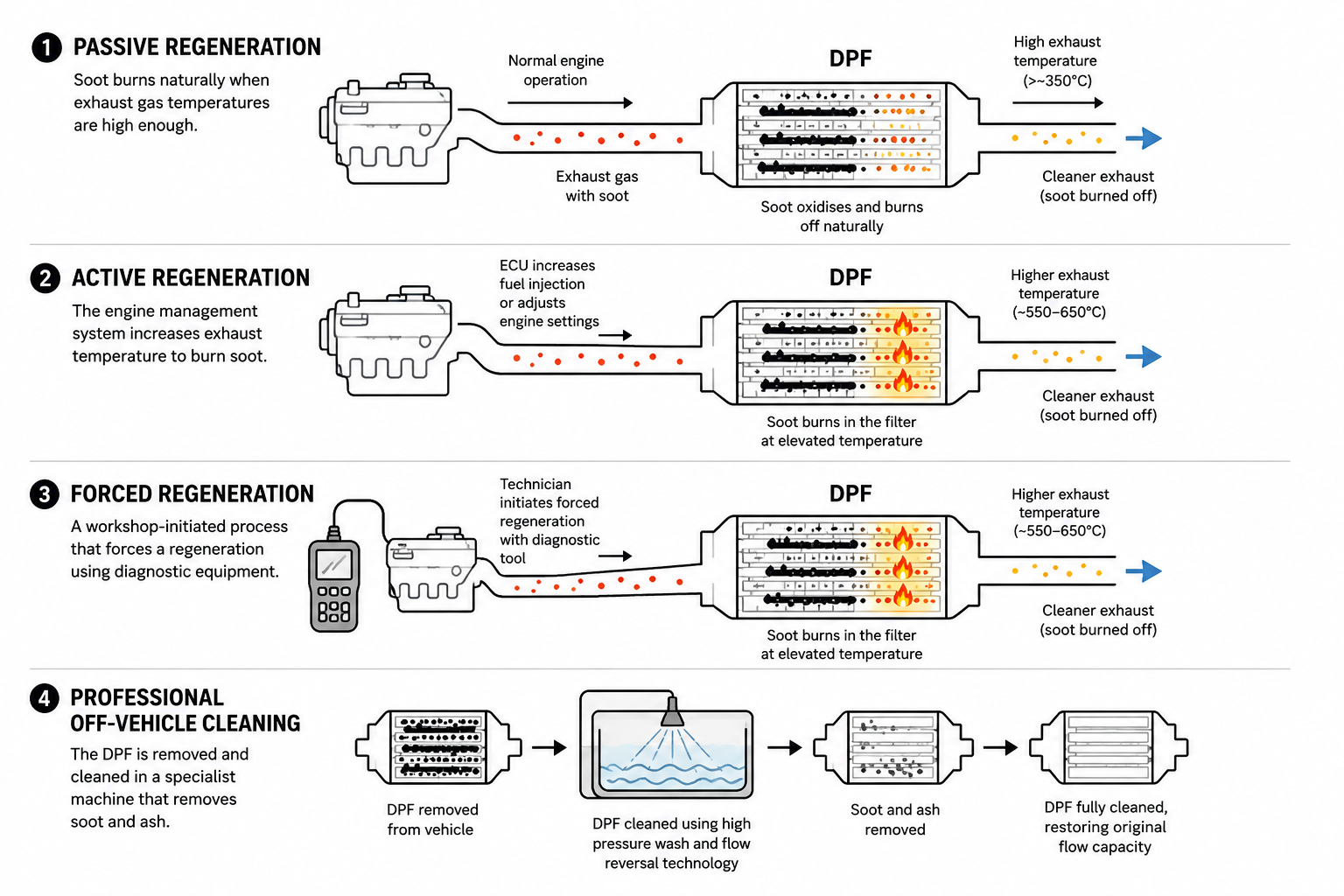
The most common “cleaning” is regeneration: the DPF burning off soot using exhaust heat, either passively on a long hot drive, actively when the engine management raises exhaust temperature, or via a forced workshop procedure. Regeneration is effective against soot. It does nothing for ash. It’s the first line of defence, not a cure for every blockage — and if regeneration keeps failing, that’s usually a sign of an underlying fault rather than a filter that just needs another burn.
2. In-car chemical cleaning
Some garages use chemical cleaners with the DPF still on the car. A product is sprayed or introduced into the filter to loosen soot and carbon deposits, left to soak, then followed by a regeneration or flushing cycle. These cleaners are typically based on detergents, surfactants that help lift and suspend deposits, water-based fluids, and sometimes mild alkaline ingredients.
This can help a soot-loaded filter where the blockage is moderate and the filter itself is still sound. But there’s a firm limit: heavy ash loading doesn’t dissolve away with a spray cleaner. If ash is the real problem, in-car chemical treatment is often only a temporary improvement.
3. Professional on-car and off-car cleaning
This is the proper solution when a DPF has built up serious ash but is still structurally sound. The key difference from a spray cleaner is that it’s designed to physically remove ash from the fine channels inside the filter, not just wash away loose soot.
Off-car cleaning removes the DPF from the vehicle and cleans it through a controlled process, typically: inspection for cracks, melting or oil contamination; back-pressure or flow testing to measure restriction; cleaning by reverse flushing, aqueous washing, pulse-air or thermal methods (or a combination); thorough drying; re-testing to confirm flow is restored; then refitting and resetting any service values.
On-car (mobile) cleaning uses the same principles without removing the filter, via a mobile cleaning machine. It’s generally suitable for vehicles that are still running — even if the ECU has already triggered limp mode — and it avoids the garage cost and downtime of removing and refitting the unit.
Which method removes what?
| Cleaning method | Removes soot | Removes ash | Best for |
|---|---|---|---|
| Regeneration (passive/active/forced) | Yes | No | Soot build-up on an otherwise healthy filter |
| In-car chemical cleaning | Partly | No (not heavy ash) | Moderate soot blockage, filter still sound |
| Professional on-car (mobile) cleaning | Yes | Yes | Soot and ash, vehicle still running / limp mode |
| Professional off-car cleaning | Yes | Yes | Heavy ash, thorough workshop clean |
The pattern is clear: only physical professional cleaning reliably removes ash. Everything above it in the list deals with soot.
What chemical actually cleans a DPF?
Drivers often ask which chemical will “melt” or “dissolve” a DPF blockage. The honest answer is that there’s no single magic chemical that solves every DPF problem. Different systems use different formulations, but the chemistry usually falls into a few broad categories: detergents to lift contamination, surfactants to penetrate and suspend deposits, alkaline cleaners for oily carbon residues, specialist low-residue cleaning fluids, and clean or deionised water as part of a controlled flush.
For soot-heavy filters, the aim is to loosen deposits enough for heat or flushing to carry them away. For ash-heavy filters, the real work isn’t done by chemistry alone — it’s the combination of flushing direction, pressure, airflow and controlled handling that shifts the ash. That’s why serious DPF cleaning is a process, not a bottle.
It’s also why improvised chemicals are a bad idea. Strong household cleaners, aggressive degreasers or unsuitable solvents can damage the DPF’s ceramic core, its catalytic coating, the sensors or the metal housing. A modern DPF is far too expensive to treat as an experiment.
When cleaning isn’t enough
Not every DPF can be saved. If the core has melted, cracked, or been badly contaminated by oil or coolant, cleaning may not restore it and replacement can be the only sensible option. A filter can also re-block quickly if the real cause lies elsewhere — faulty injectors, poor turbo performance, EGR faults, failing sensors, low operating temperature or excessive oil consumption can all overload a filter that was only just cleaned. That’s why the best DPF work is never just “clean it and hope”; a good workshop also wants to know why it blocked in the first place.
Does DPF cleaning improve performance and fuel economy?
This is the question most owners care about, and the honest answer is: it depends almost entirely on how restricted the filter was to begin with.
If the filter was only mildly restricted, the difference may be small — slightly crisper response, fewer regeneration events, a modest fuel-economy improvement, and little obvious change in peak power. The car was never far from normal.
If the filter was badly restricted, the change can be dramatic — stronger acceleration, better turbo response, smoother pulling under load, less tendency to drop into limp mode, lower fuel consumption and fewer active regenerations. The reason is back-pressure: a badly blocked DPF forces the engine to work harder to push exhaust out, which hurts how it breathes and how the turbo behaves, and the ECU may cut power to protect the hardware. Cleaning doesn’t add power the engine never had — it restores what was being lost to restriction.
So there’s no honest one-size-fits-all figure. On one car the gain is barely noticeable; on another it feels like a different vehicle. As a rule, the worse the restriction, the bigger the improvement after a proper clean.
The oil point many owners miss
One overlooked part of DPF life is engine oil. Many DPF-equipped diesels require a low-SAPS oil — formulated to produce lower levels of sulphated ash, phosphorus and sulphur. Using the wrong oil may not cause an immediate problem, but over time it increases ash accumulation and shortens the filter’s useful life. It’s not a mistake that shows up overnight, which is exactly why it’s so easy to make.
The simple version
- A soot-loaded DPF may recover with regeneration or mild chemical treatment.
- An ash-loaded DPF usually needs professional on-car or off-car cleaning — and occasionally replacement.
- There’s no magic bottle: real cleaning is a controlled process of flushing, pressure and airflow.
- If the filter was badly blocked, a proper clean can noticeably restore performance and fuel economy.
Get your DPF cleaned properly
A blocked DPF is often an engine-behaviour problem that shows up in the exhaust — so proper DPF care is about more than clearing a warning light. Our mobile engineers come to your home or workplace, run full diagnostics to find the real cause, and deep-clean the filter on the spot to remove both soot and ash, then regenerate and reset it — usually in about an hour, for a fraction of the cost of replacement. For heavily ash-loaded filters we also offer a thorough off-car cleaning service.
Call us on 0333 366 1404 for advice or to book, or send an enquiry here. You can also read more on how DPF regeneration works or whether DPF additives work.
Frequently asked questions
What chemical is used to clean a DPF?
There’s no single chemical that dissolves a blockage. Professional systems use combinations of detergents, surfactants, mild alkaline cleaners and water-based flushing fluids — but on ash-heavy filters the real cleaning comes from controlled flushing, pressure and airflow, not chemistry alone.
Can you clean a DPF without removing it?
Yes. On-car (mobile) cleaning uses the same principles as off-car cleaning without taking the filter off the vehicle, and is generally suitable even if the car is in limp mode. Off-car cleaning is reserved for heavily ash-loaded filters that need a full workshop clean.
Does DPF cleaning improve performance?
It restores performance lost to restriction rather than adding new power. On a mildly blocked filter the gain is small; on a badly blocked one you may notice stronger acceleration, better turbo response, fewer regenerations and improved fuel economy.
Will cleaning fix a DPF that keeps blocking?
Only if the underlying cause is addressed. A filter that re-blocks quickly usually has another fault behind it — injectors, EGR, turbo, sensors or oil consumption — which is why diagnostics matter as much as the clean itself.