

DPF Regeneration Explained: How Diesel Particulate Filters Clean Themselves
The short answer
Regeneration is how your DPF cleans itself — it burns trapped soot off into gas, leaving only a tiny amount of ash behind. There are four types: passive (happens naturally on a good run), active (your car forces it), driver-assisted (you provide the conditions to finish one), and forced (a garage commands it). The catch: regeneration removes soot, but never ash. Ash builds up for the life of the filter, and once it does, no amount of regeneration will clear it.
WHITE PAPER.
Author: Daniel Garside, owner and manager of national automotive repair and rescue companies since 2008
If you drive a diesel, you’ve probably heard the term “DPF regeneration” — usually the moment a warning light appears at the worst possible time. It sounds technical, but the idea is simple: your diesel particulate filter has to clean itself, and regeneration is how it does it. Understanding the four ways it happens — and the one thing it can never fix — tells you most of what you need to know about keeping your DPF healthy. Here’s the full picture in plain English.
What is regeneration?
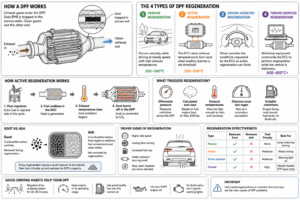
Your DPF traps the soot (carbon particles) that diesel combustion produces. Left alone, that soot would eventually block the filter solid. Regeneration is the process of burning that trapped soot off — oxidising it into carbon dioxide — leaving behind only a small amount of non-combustible ash.
That distinction between soot and ash is the single most important thing to understand about your DPF:
- Soot is combustible carbon — regeneration burns it away.
- Ash is the incombustible residue left from engine oil additives, fuel and wear metals — regeneration cannot remove it.
Plenty of drivers believe a regeneration “cleans the DPF completely”. It doesn’t. It removes soot. Ash quietly accumulates over the filter’s whole life, and eventually it has to be cleaned out professionally or the filter replaced.
Want to know what that professional cleaning actually involves? See our guide: How is a DPF actually cleaned?
Where the DPF sits in your exhaust
The DPF doesn’t work alone. It’s one part of your exhaust aftertreatment system, and the parts around it matter for regeneration. Exhaust leaves the engine and passes first through the DOC (diesel oxidation catalyst), which converts some of the engine’s nitric oxide into nitrogen dioxide — useful, because nitrogen dioxide helps burn soot at lower temperatures. It then reaches the DPF itself, where soot is trapped in the filter’s porous walls. On many modern diesels there’s also an SCR (selective catalytic reduction) stage further down, which uses AdBlue to cut nitrogen oxides. Regeneration is mainly about the DPF, but the DOC in front of it plays a direct role in making it happen.
The four types of DPF regeneration
Most guides mention three. From an engineering point of view there are really four, because the one drivers are asked to do themselves is worth understanding separately.
1. Passive regeneration
This is the DPF cleaning itself naturally as you drive, with no intervention from the car’s computer. It simply happens whenever the exhaust stays hot enough for long enough — typically around 350–500°C — for soot to burn off continuously. That means motorway runs, sustained A-road driving, towing, carrying heavy loads or long uphill climbs.
Passive regeneration is the best kind: most fuel-efficient, gentlest on the filter, least stressful on the engine. The problem is that a lot of modern diesels rarely spend enough time in those conditions. If your car mostly does school runs, urban commutes or short delivery hops, it may get little or no passive regeneration — which is exactly where DPF trouble starts.
2. Active regeneration
When passive regeneration hasn’t cleared enough soot, the engine computer (ECU) steps in and deliberately raises the exhaust temperature to burn it off — usually to around 550–650°C. This is the regeneration most drivers actually experience, and it’s triggered once the ECU calculates that soot loading has passed a set threshold.
To get the exhaust that hot, the ECU typically injects a little extra fuel late in the combustion cycle (post injection), which then oxidises in the DOC and generates heat. Some systems use a dedicated injector in the exhaust instead. The ECU may also raise idle speed, adjust the turbo, alter EGR operation or switch on electrical loads to help things along. You might notice a higher idle, cooling fans running, a faint burning smell, slightly worse fuel economy or stop-start being disabled — though many cars hide it almost completely.
The downsides: active regeneration uses extra fuel, can dilute your engine oil if it’s repeatedly interrupted, and puts more thermal stress on the turbo, DPF and exhaust. A completed active regen, though, clears most of the soot and returns the filter close to normal.
3. Driver-assisted (driving) regeneration
This isn’t really a separate process — it’s an active regeneration that needs your help to finish. When the DPF warning light appears, the car is telling you it has been trying to regenerate but can’t complete the cycle in your current driving. The usual advice is to drive above 40–50 mph at a steady speed for 15–30 minutes. You’re not doing anything to the car directly; you’re just giving the ECU the conditions it needs to finish the job. It’s widely misunderstood, which is why it’s worth naming on its own.
4. Forced (service) regeneration
If soot loading climbs too high for a normal active regeneration to run, a garage can command one using diagnostic equipment, with the vehicle stationary. It runs at the hottest temperatures of all — around 600–650°C or more — and only works if the blockage is primarily soot. It can’t touch ash, a melted or cracked substrate, or oil contamination.
It’s a recovery tool, not a long-term fix — and repeated forced regens carry real risks to your engine and a genuine fire hazard if done badly. We cover when it helps, when it does more harm than good, and the safer alternative in detail here: What is a forced regen?
What actually triggers a regeneration?
A common myth is that regeneration runs on mileage alone. In reality the ECU weighs several inputs at once before deciding:
- Differential pressure across the DPF — how restricted the filter is.
- A calculated soot model — an estimate built from fuel injected, engine load, air flow, EGR rate and driving style.
- Exhaust temperatures — to confirm it’s hot enough to start and sustain a burn.
- Distance since the last regeneration — a secondary safety check.
- Driving conditions — enough engine temperature, enough fuel in the tank, suitable road speed, stable running and no emissions faults.
If those conditions aren’t met, the regeneration is simply postponed.
Why regeneration sometimes fails
A DPF that won’t regenerate is often telling you about a different problem. Common causes include repeated short journeys, regenerations that keep being interrupted, faulty temperature or pressure sensors, sticking EGR valves, leaking injectors, turbocharger faults, too much engine oil, the wrong low-quality oil, and on some systems failed glow plugs. In other words, a regeneration request is frequently a symptom rather than the root cause — which is why pouring in a fix without diagnosing the real fault rarely lasts.
How effective is each type?
| Regeneration type | Removes soot | Removes ash | Fuel penalty | Best for | Typical temp. |
|---|---|---|---|---|---|
| Passive | Yes (ideal conditions) | No | None | Long-distance driving | 350–500°C |
| Active | Yes | No | Moderate | Mixed driving | 550–650°C |
| Driver-assisted | Yes (if completed) | No | Moderate | When the warning light shows | 550–650°C |
| Forced (service) | Yes (soot only) | No | High | Heavily loaded filters | 600–650°C+ |
Notice the second column: not one type removes ash. That’s the whole point — every regeneration, however it’s triggered, only deals with soot.
The biggest misconception about regeneration
It’s worth repeating, because it’s the misunderstanding that catches most drivers out: regeneration does not “clean” your DPF. It removes soot, but every successful regeneration leaves a little ash behind. Over tens of thousands of miles that ash gradually fills the filter’s channels, reducing how much soot it can hold and making regenerations happen more and more often. Eventually the filter has to be removed for specialist cleaning, or replaced.
How to help your DPF look after itself
- Drive at a steady speed for 20–30 minutes regularly to let passive and active regeneration complete.
- Don’t switch off mid-regeneration where you can safely keep driving — interrupted regens raise soot loading and can dilute your oil.
- Use the correct low-SAPS engine oil. Its reduced sulphated ash, phosphorus and sulphur content slows the permanent ash build-up inside the DPF and extends its life.
- Use good-quality fuel and fix faults early — don’t ignore a warning light, since the underlying fault is usually what’s stopping regeneration.
When regeneration can’t fix it — what we do
If your DPF light keeps coming back, your regenerations never seem to finish, or you’re in limp mode, the filter has usually reached the point where regeneration alone can’t recover it — typically because of ash, or an underlying fault. That doesn’t mean an expensive new filter. Our mobile engineers come to your home or workplace, run full diagnostics to find the real cause, and deep-clean the DPF on the spot to remove both soot and ash, then regenerate and reset it — usually in around an hour, for a fraction of the cost of replacement.
Call us on 0333 366 1404 for advice or to book, or send an enquiry here. You can also read more on forced regeneration or whether DPF additives work.
Frequently asked questions
How long does a DPF regeneration take?
An active regeneration usually takes around 10–20 minutes, but it needs the right conditions to complete — which is why the advice is to keep driving steadily for 15–30 minutes when the light shows.
Does regeneration clean the DPF completely?
No. Regeneration removes soot but leaves ash behind. Ash gradually builds up over the filter’s life and eventually needs professional cleaning or replacement.
What happens if I interrupt a regeneration?
Repeatedly stopping the engine mid-regeneration lets soot keep building and, on engines using post-injection, can dilute the engine oil. The occasional interruption isn’t a disaster, but a pattern of short trips that never let regeneration finish is a leading cause of blockages.
Why does my DPF keep needing to regenerate?
Frequent regenerations often point to short-journey driving, building ash, or an underlying fault such as a faulty sensor, EGR or injector problem. If it’s happening a lot, it’s worth getting diagnosed rather than just driving through it.