

DPF and Catalytic converter sensor data, fault codes index, and failure consequences. A guide for workshops and fleet managers.
CODE FAMILIES
Codes shown are the generic OBD-II / EOBD codes (SAE J2012 standard). Most manufacturers use these exactly; some (VW/Audi Group, PSA, Ford, GM, and heavy-duty trucks) also use manufacturer-specific P1xxx / P3xxx codes, or proprietary SPN/FMI codes on trucks and buses, for the same underlying faults. Cross-check against the OEM database if a generic code doesn’t fully match the symptoms in front of you.
BANK & SENSOR NUMBERING
Bank 1 / Bank 2
— the side of a V-configured engine; Bank 1 contains cylinder No.1. Inline engines only ever report Bank 1.
Sensor 1 / 2 / 3
— position along the exhaust: Sensor 1 is closest to the engine (upstream); higher numbers sit progressively further downstream, toward the tailpipe.
DIAGNOSTIC ORDER
If a pressure-sensor or EGT-sensor circuit code (e.g. P2453, P0546) is present alongside an efficiency code (e.g. P2002, P0420), diagnose and clear the sensor/circuit code first. A bad sensor reading is one of the most common root causes of a false efficiency code — roughly a third of DPF/catalyst codes trace back to a sensor, connector or`wiring fault rather than a failed part.
READING THE CONSEQUENCE TAGS
MILD — IF IGNORED
What typically happens if the vehicle keeps running with this code for a short period:
economy loss, minor performance drop, a failed emissions test.
SEVERE — IF IGNORED
What happens with prolonged neglect:
component damage, limp mode, a breakdown, or a repair bill that’s an order of magnitude larger.
Scroll to relevant section for full details on each code
PART 1: CATALYST CODES
P0420
P0430
P0421
P0431
P0422
P0432
P0424
P0434
PART 2: DPF CODES
P2002
P2003
P2452
P2453
P2454
P2455
P244A
P244B
P2459
P2463
P242F
PART 3 & 4: EGT & PRESSURE CODES
P0545 / P0546
P0548 / P0549
P2032 / P2033
P0471 / P0472 / P0473
1. CLEAR CODES AND ROAD-TEST AFTER EVERY REPAIR
Many DPF and catalyst efficiency codes require a full drive cycle — including a sustained highway-speed section — before the monitor re-runs and confirms the fix
.
2. DON’T REPLACE HARDWARE ON AN EFFICIENCY CODE ALONE
If a related sensor/circuit code is present alongside an efficiency code, fix the sensor or wiring first, clear codes, and re-test. A large proportion of “failed” catalysts and DPFs turn out to be sensor or wiring faults.
3. FOR FLEET MANAGEMENT: DRIVING PATTERN DRIVES THESE CODES
Part 2 and Part 3 codes (DPF and EGT) are strongly linked to how a vehicle is used — vehicles doing predominantly short, low-load trips are disproportionately likely to set them. Route planning that allows periodic sustained higher-speed running can meaningfully cut DPF-related downtime and cleaning/replacement costs across a fleet.
4. CONFIRM AGAINST OEM DOCUMENTATION
Codes and thresholds can vary between manufacturers even where the generic P-code text is identical. Confirm against OEM technical documentation before committing to a major repair. Manufacturer-specific codes (e.g. heavy-duty truck SPN/FMI codes, or OEM P1xxx codes) follow the same diagnostic logic as the codes in this guide but should be cross-checked against service documentation.
Efficiency codes for the three-way catalyst (petrol/gasoline engines) and the diesel oxidation catalyst (DOC), which sits upstream of the DPF on diesel vehicles and can trigger the same family of codes.
CODE NUMBERS: P0420 / P0430 / P0421 / P0431 / P0422 / P0432 / P0424 / P043
What it means:
The main catalytic converter is no longer converting exhaust gases (CO, HC, NOx) as efficiently as the ECU expects.
TRIGGERING SENSORS & LOCATION
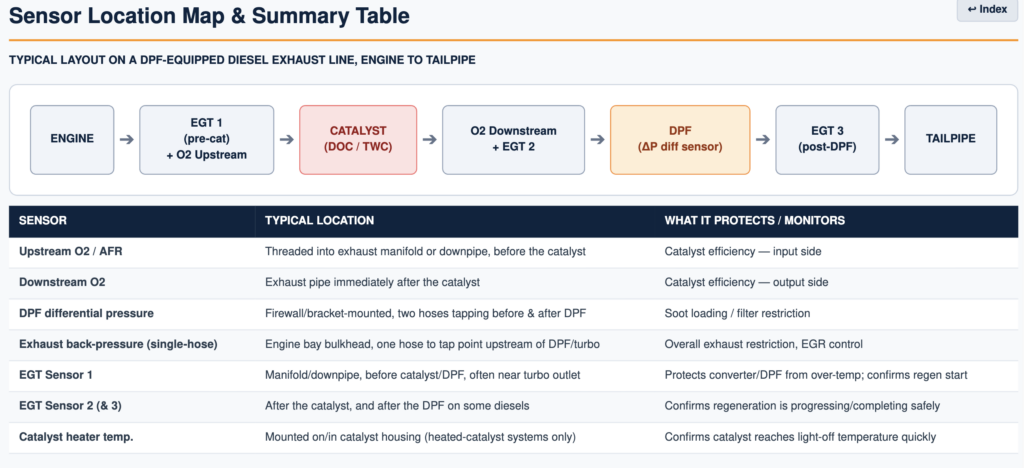
Upstream O2/AFR sensor, threaded into the manifold or downpipe before the catalyst, and a downstream O2 sensor immediately after it.
The ECU compares their switching patterns — a healthy catalyst keeps the downstream signal flat.
PROBABLE CAUSES
Degraded/melted substrate (oil burning, coolant leak, overheating)
Unresolved misfire (P0300 series) dumping fuel into the catalyst
Failing or contaminated O2 sensors
Exhaust leak near either sensor
Aftermarket converter below the efficiency threshold
IF IGNORED:
MILD
Failed emissions test, slightly reduced economy, faint sulphur smell — often no drivability change at all.
SEVERE
Substrate breaks apart internally, blocking exhaust flow — major power loss,
exhaust overheating (fire risk), and debris can be drawn back into a cylinder.
What it means:
Same efficiency concept as P0420/P0430, but for a small “warm-up” catalyst mounted close to the manifold (common on Honda, Mazda, Mitsubishi, some Toyota) that’s designed to light off quickly and cut cold-start emissions.
TRIGGERING SENSORS & LOCATION
Same upstream/downstream O2 sensor pair, positioned around the small close-coupled warm-up catalyst rather than the main underfloor unit.
PROBABLE CAUSES
Same root causes as P0420/P0430
Excessively rich cold-start fuelling
Leaking manifold gasket near the warm-up catalyst
Heat shield fault skewing the sensor reading
IF IGNORED:
MILD
Failed emissions test; slightly worse cold-start emissions and fuel trim.
SEVERE
Same substrate break-up risk as P0420 — debris is more likely to migrate downstream and damage the main catalyst too.
What it means:
Used on systems that separately monitor the main underfloor catalyst as distinct from a warm-up catalyst.
TRIGGERING SENSORS & LOCATION
Downstream O2/AFR sensor positioned after the main (underfloor) catalyst.
PROBABLE CAUSES
Functionally identical to P0420/P0430 — use the same diagnostic logic.
IF IGNORED
MILD
As P0420/P0430: emissions failure, minor economy loss.
SEVERE
As P0420/P0430: substrate breakup and potential engine damage from debris.
What it means:
Applies to electrically-heated catalyst systems (less common, mostly older low-emission vehicles). The catalyst isn’t reaching operating temperature quickly enough.
TRIGGERING SENSORS & LOCATION
Catalyst temperature sensor mounted directly on/in the catalyst housing, plus the heater circuit itself.
PROBABLE CAUSES
Failed catalyst heater element
Blown heater fuse or relay
Wiring fault or faulty temperature sensor
IF IGNORED
MILD
Elevated cold-start emissions; possible emissions test failure.
SEVERE
Rare — a control-strategy fault rather than a mechanical-damage risk, though
prolonged cold-start richness accelerates normal catalyst aging.
Diesel Particulate Filter codes: soot loading, differential pressure, regeneration frequency, and physical filter restriction or damage.
CODE NUMBERS: P2002/3 / P2452–5 / P244A / P244B / P2459 / P2463 / P242F
What it means:
The ECU has calculated the DPF is no longer filtering soot to the expected standard — either it’s too full (restricted) or, less commonly, damaged/cracked and letting soot pass through.
TRIGGERING SENSORS & LOCATION
DPF differential (delta) pressure sensor, usually bracket-mounted near the DPF, connected by two small hoses tapping the exhaust just before and just after the filter.
Cross-checked against EGT sensors before/after the DPF.
PROBABLE CAUSES
Soot overload from repeated short trips (regen never completes)
Failed or overdue regeneration cycles
Cracked/melted substrate after a runaway regen
Faulty pressure sensor or blocked/split hoses
Poor fuel quality or oil contamination increasing soot load
IF IGNORED
MILD
DPF warning light, slightly reduced power/economy, more frequent regeneration
attempts.
SEVERE
Complete blockage forcing limp mode; an uncontrolled forced regen can melt the
substrate or ignite accumulated soot — full DPF replacement.
What it means:
No signal, or an implausible signal, from the DPF differential pressure sensor circuit.
TRIGGERING SENSOR & LOCATION
DPF differential pressure sensor and its wiring/connector — bracket-mounted, dual hose take-off before/after the DPF.
PROBABLE CAUSES
Open/short circuit, corroded connector pins, sensor failure, or a disconnected sensor.
IF IGNORED
MILD
Regeneration strategy runs “blind” — may regenerate too often (wasted fuel) or too
rarely.
SEVERE
ECU can’t verify actual filter loading and may fail to trigger regeneration when
genuinely needed — hard blockage and limp mode.
What it means:
The sensor produces a signal, but it’s outside the plausible range for current operating conditions — often a reading that doesn’t move, or moves the wrong way relative to engine load.
TRIGGERING SENSOR & LOCATION
Same DPF differential pressure sensor as P2452.
PROBABLE CAUSES
Blocked, split, kinked or swapped sensor hoses (soot/condensate blockage is very common here), a degraded sensor diaphragm, or an out-of-calibration sensor.
IF IGNORED
MILD
Inaccurate soot-load estimate; unnecessary or delayed regenerations.
SEVERE
A frequent root cause behind a “false” P2002 — if unresolved, can lead to an
unnecessary and costly filter replacement despite the DPF itself being fine.
What it means
Voltage from the differential pressure sensor circuit is stuck below (P2454) or above (P2455) the expected range.
TRIGGERING SENSOR & LOCATION
Same DPF differential pressure sensor and hose assembly as P2452/P2453.
PROBABLE CAUSES
Short to ground (Low) or short to voltage/open circuit (High); a disconnected hose
reading atmospheric pressure instead of exhaust pressure; failed sensor.
IF IGNORED
MILD
Unreliable soot-load data feeding the regeneration strategy.
SEVERE
As P2452/P2453 — poor regen timing leading to filter blockage or an unnecessary
replacement.
What it means:
The pressure drop across the DPF is lower than it should be for current exhaust flow — the opposite problem to a clogged filter.
TRIGGERING SENSOR & LOCATION
DPF differential pressure sensor, as above.
PROBABLE CAUSES
Cracked/melted substrate letting exhaust bypass the filter media (soot bridging or a burned-through core), an exhaust leak between the two pressure taps, or a disconnected/leaking sensor hose.
IF IGNORED
MILD
Often no drivability symptom at all — engine runs fine, so this code is easy to
overlook.
SEVERE
A physically breached filter emits particulates well above legal limits and will fail an
emissions/MOT test outright; it can’t be cleaned, only replaced.
What it means:
The classic “blocked filter” code — pressure drop across the DPF is higher than expected, meaning exhaust flow is heavily restricted.
TRIGGERING SENSOR & LOCATION
DPF differential pressure sensor, as above.
PROBABLE CAUSES
Heavy soot or ash accumulation, failed regeneration cycles, a blocked sensor hose exaggerating the reading, or (rarely) physical collapse inside the filter housing.
IF IGNORED
MILD
Reduced power, poor economy, DPF light, frequent regen attempts that don’t fully
clear it.
SEVERE
Complete blockage → limp mode → possible turbo damage from excess
backpressure → stalling risk in traffic. A common cause of unplanned fleet
downtime.
What it means:
The ECU is initiating regeneration cycles far more often than normal — the filter isn’t holding a clean state between regens.
SENSORS INVOLVED
Differential pressure sensor and EGT sensors feed the soot-load model that sets regen frequency; this is a calculated/performance code, not a single circuit fault.
PROBABLE CAUSES
Mostly short, low-speed trips that never reach regen temperature; developing internal filter damage reducing capacity; EGR or injector faults increasing soot production.
IF IGNORED
MILD
Increased fuel use from constant regen attempts; extra oil dilution from post-
injection fuel used during regen.
SEVERE
Accelerated filter aging leading to premature P2002/P244B codes; diluted oil can
cause internal engine wear if oil changes aren’t shortened.
What it means:
The ECU’s calculated soot mass in the filter has exceeded the maximum safe limit.
TRIGGERING SENSORS & LOCATION
Same differential pressure sensor and EGT sensors used for the soot-mass model (before/after DPF).
PROBABLE CAUSES
As P244B — failed/incomplete regens, short-trip driving, EGR fault increasing soot load, or a falsely high sensor reading.
IF IGNORED
MILD
DPF light, noticeably reduced performance; ECU may derate engine power to
protect the filter.
SEVERE
Full blockage requiring forced regen, professional cleaning, or replacement; driving
on in a derated state raises roadside breakdown risk.
Exhaust Gas Temperature sensors don’t measure soot or emissions directly — but they protect the catalyst and DPF from heat damage, and the ECU relies on them to know when a regeneration is safe to run.
CODES: P0545 / P0546 / P0548 / P0549 / P2032 / P2033
What it means:
Implausible voltage from the first EGT sensor in the exhaust — closest to the engine, before the catalyst/DPF.
TRIGGERING SENSOR & LOCATION
EGT Sensor 1 — in the exhaust manifold or downpipe, ahead of the catalytic converter (petrol) or ahead of the DPF/DOC (diesel), often near the turbo outlet.
PROBABLE CAUSES
Failed sensor element
Damaged or corroded connector
Wiring insulation melted from heat exposure (common near the turbo)
Aftermarket exhaust with no sensor provision
IF IGNORED
MILD
Check engine light with no immediately obvious drivability change.
SEVERE
On diesels, regeneration is commonly disabled entirely until fixed — progressive
filter clogging and eventual limp mode. On any engine, an unmonitored over-
temperature event can permanently damage the catalyst or DPF substrate.
P0548 / P0549 EGT SENSOR CIRCUIT LOW / HIGH — BANK 2, SENSOR 1
What it means:
Same fault as P0545/P0546, on the opposite bank of a V- configuration engine.
Triggering Sensor:
EGT Sensor 1 on Bank 2 — mirrored position to Bank 1 Sensor 1.
Probable Causes / Mild / Severe:
Identical to P0545/P0546.
P2032 / P2033 EGT SENSOR CIRCUIT LOW / HIGH — BANK 1, SENSOR 2
What it means:
Implausible voltage from the second EGT sensor, positioned further downstream than Sensor 1.
Triggering Sensor:
EGT Sensor 2 — after the catalytic converter or after the DPF, monitoring outlet temperature.
Probable Causes:
Sensor failure, connector corrosion, wiring damage.
Severe:
ECU cannot verify a regen completed safely — risking incomplete regen
or unmonitored over-temperature.
Some diesel platforms use a single absolute exhaust back-pressure sensor, in addition to or instead of the DPF differential sensor, to help monitor filter loading and EGR function.
CODES: P0471 / P0472 / P0473
What it means:
An implausible, low, or high signal from a single absolute exhaust back-pressure sensor used (on some platforms) to help monitor DPF loading and EGR function.
TRIGGERING SENSOR & LOCATION
Exhaust back-pressure sensor, typically bulkhead-mounted with a single pressure hose running to a tap point upstream of the DPF/turbo.
PROBABLE CAUSES
Blocked or split sensor hose (soot/condensate is a very common cause)
Failed sensor
Wiring fault
IF IGNORED
MILD
Inaccurate backpressure data feeding the EGR and regen strategy; minor performance/economy loss.
SEVERE
Miscalculated backpressure can mask a genuinely restricted DPF, or push EGR
outside safe limits — increasing soot production and accelerating filter loading.
View/download a pdf version of this guide below