

Diesel Fleet Compliance: DPF Legal Requirements and Best Practice Maintenance
Introduction
Diesel fleet compliance now depends on more than buying Euro-compliant vehicles. Diesel engines remain essential across transport, construction, agriculture and commercial fleets because of their fuel efficiency and durability, but modern diesel engines only meet today’s emissions legislation because they rely on sophisticated aftertreatment systems — particularly the Diesel Particulate Filter (DPF).
For fleet managers, this creates an important responsibility. Compliance also depends on ensuring emissions-control systems continue to function correctly throughout the vehicle’s life. Increasingly, regulators are placing greater emphasis on in-service emissions performance, not just emissions at the point of manufacture.
Why DPFs are legally important
DPFs are not an optional accessory. Their purpose is to remove approximately 95–99% of soot particles before they leave the exhaust. Without them, modern diesel engines cannot meet:
- Euro 5
- Euro 6
- Euro VI (heavy vehicles)
Removing or disabling a DPF causes particulate emissions to increase dramatically and makes the vehicle non-compliant with type approval and MOT requirements.
The legal position in the UK
Type approval
All new vehicles are approved to specific emissions standards, such as:
- Euro 5
- Euro 6
- Euro VI
The DPF forms part of that approval. Removing it changes the vehicle’s certified emissions performance, and violates MOT requirements.
Construction and Use Regulations
It is illegal to use a vehicle on the road if emissions equipment has been removed or deliberately rendered inoperative. That includes:
- DPF removal
- Internal gutting
- Software that disables regeneration
- Emulator devices
MOT requirements
Fleet managers are often surprised by this. Current MOT inspections include:
- Visual confirmation that a DPF is present where originally fitted.
- Excessive smoke testing.
- Inspection for obvious tampering.
A missing or obviously modified DPF is normally an MOT failure, and a failed MOT takes the vehicle off the road until it is resolved — one of the real costs of leaving a blocked DPF untreated. However, it should also be noted that:
- Passing an MOT does not prove the DPF is working efficiently.
- An ageing filter may still pass an MOT while operating well below its original efficiency.
Why compliance is becoming more demanding
Historically, regulations focused mainly on manufacturers. The direction of travel is now towards ensuring vehicles remain clean throughout their working lives. This is where Euro 7 emissions standards become important.
Although Euro 7 does not require existing vehicles to be upgraded, it reflects a significant policy shift by placing much greater emphasis on emissions durability, real-world testing and lifetime compliance. The UK is consulting on aligning Great Britain with the Euro 7 framework for new vehicles, which would introduce stricter in-service conformity requirements similar to those adopted in the EU. We cover what changes between Euro 6 and Euro 7 in detail in our guide to the new standards.
The essential point for fleet operators is that emissions compliance is increasingly viewed as a whole-life responsibility, not simply a standard met when a vehicle leaves the factory.
Which Euro standards require a DPF?
| Standard | Typical introduction | DPF required? |
| Euro 4 | Some models | Usually no |
| Euro 5 | Yes | Almost always |
| Euro 6 | Yes | Always |
| Euro VI trucks | Yes | Always |
Euro 6 introduced tighter NOx limits, improved regeneration strategies, SCR systems, AdBlue and sophisticated DPF monitoring — all of which mean the aftertreatment system on a modern fleet vehicle has more ways to record, and report, a filter that is no longer performing.
The consequences of poor DPF maintenance
Many fleets assume that the DPF only needs attention once the warning light comes on. Unfortunately, by then the filter is often already heavily contaminated. By that time, exhaust gases are already restricted by build-up of ash and soot within the DPF, with consequent impact on engine power output, fuel consumption and engine wear.
Ash accumulation
Unlike soot, ash cannot be burned away. It comes from:
- engine oil additives
- metal wear particles
- fuel contaminants
Every regeneration leaves the ash behind. Eventually the filter loses capacity.
Higher exhaust back pressure
Consequences include:
- increased fuel consumption
- turbocharger stress
- higher exhaust temperatures
- reduced power
- more frequent regenerations
Oil dilution
Repeated interrupted regenerations can allow diesel fuel to enter the engine oil. That leads to:
- reduced lubrication
- accelerated engine wear
- increased maintenance costs
Why regeneration is not enough
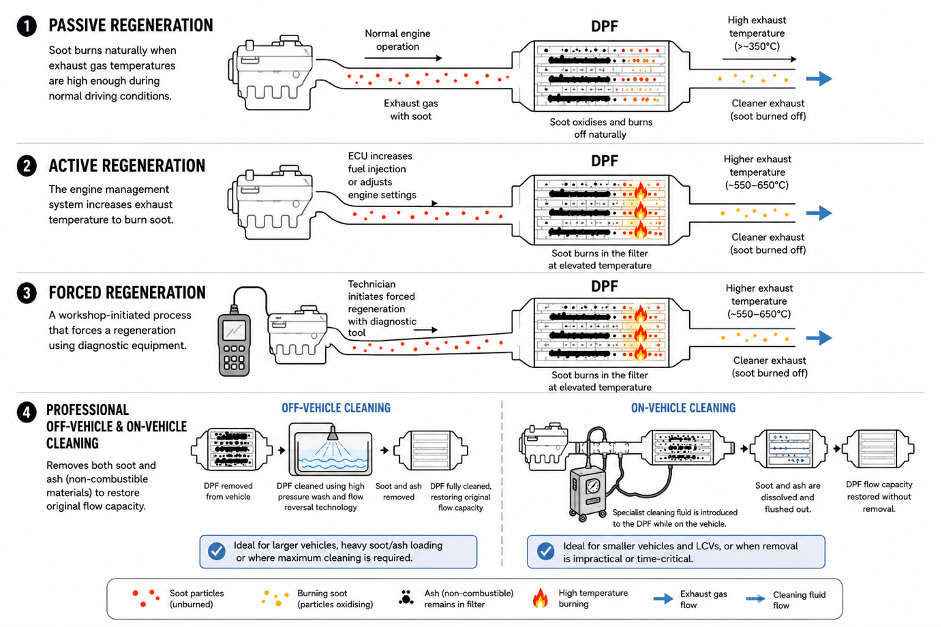
Regeneration removes soot. It does not remove ash. A vehicle that regenerates successfully every week can still eventually require professional cleaning, and this point is frequently missed by fleet managers. If you want the full mechanism — passive, active, driver-assisted and forced — see our article on how DPF regeneration works, and our guide to forced regeneration for when a workshop procedure does and does not help.
When should a fleet DPF be professionally cleaned?
Our general guidance for mixed-use diesel cars and vans is a professional clean every 20,000 miles or 24 months. For fleets, however, mileage alone is the wrong trigger. Intervals should be adjusted for:
- duty cycle
- idle hours
- engine condition
- oil consumption
- regeneration frequency
In practice that means urban fleets should be inspected earlier, long-haul vehicles can run longer intervals, and high-idle fleets need shorter ones. HGVs are more commonly scheduled by engine hours than by mileage. Professional cleaning is preventative maintenance, undertaken before excessive ash loading leads to loss of performance or costly component failures — which is why we build scheduled preventive DPF maintenance plans around each fleet’s operating pattern rather than a single fixed number.
What constitutes professional DPF cleaning?
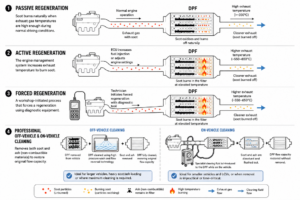
Regeneration and cleaning are not the same thing, and the distinction matters when you are planning a maintenance budget. Passive regeneration burns soot naturally. Active regeneration is commanded by the ECU. Forced regeneration is a workshop procedure that removes soot only. Professional on-vehicle or off-vehicle cleaning is the only process that removes:
- soot
- ash
- non-combustible contaminants
This restores flow capacity far more effectively than regeneration alone. You can read the full method in how a DPF is professionally cleaned. For fleets we offer mobile on-vehicle cleaning at your depot for cars and LCVs, off-car factory cleaning where the filter is removed, and catalytic converter cleaning where the wider aftertreatment system is also restricted.
Best practice for fleet managers
A practical diesel fleet compliance checklist would include:
- Monitor regeneration frequency.
- Investigate repeated active regenerations.
- Use the correct low-SAPS engine oil, which slows permanent ash build-up.
- Maintain injectors and turbochargers.
- Avoid excessive idling.
- Monitor differential pressure trends.
- Schedule preventative DPF inspections rather than waiting for warning lights.
- Include professional DPF cleaning within the planned maintenance programme where operational data indicates significant ash loading.
- Use remote telematics and diagnostics to inform preventive, condition-based maintenance.
- Keep written cleaning and diagnostic reports for each vehicle, so the maintenance history stands up to audit.
It is also worth making sure drivers and workshop staff are working from accurate information — several of the most common DPF cleaning myths lead directly to deferred maintenance and avoidable failures.
Looking ahead
The regulatory direction is firmly towards higher standards of inspection and compliance, with lower emissions and higher standards of DPF maintenance. Although Euro 7 does not require existing diesel vehicles to be retrofitted, it reinforces several long-term trends:
- greater emphasis on emissions durability
- more real-world emissions monitoring
- longer design-life expectations for emissions-control systems
- increasing reliance on onboard diagnostics and emissions monitoring
- greater scrutiny of the condition of emissions systems throughout a vehicle’s service life rather than solely at initial type approval
For fleet operators, this means that maintaining the DPF as an effective emissions-control device is becoming an increasingly important part of compliance, asset protection and operational efficiency.
Key takeaways for fleet managers
- A DPF is a legally required emissions-control device on most modern diesel vehicles and must remain fitted and functional.
- Routine regeneration removes soot but does not remove ash, so it cannot prevent long-term DPF loading.
- Excessive ash accumulation increases back pressure, fuel consumption, regeneration frequency and the risk of expensive engine and turbocharger problems.
- Passing an MOT does not necessarily confirm that a DPF is operating at peak efficiency.
- Preventative inspection and professional DPF cleaning — off-vehicle, or on-vehicle where suitable, such as cars and LCVs — informed by duty cycle and diagnostic data, can extend DPF service life, support emissions compliance and reduce total fleet operating costs.
- As emissions legislation evolves towards lifetime compliance and durability, planned DPF maintenance should be regarded as a core element of fleet maintenance strategy rather than a reactive repair.
Keep your fleet compliant and on the road
DPF Fixer provides nationwide mobile and off-car DPF cleaning for cars, vans, HGVs, buses, plant and agricultural equipment, with full diagnostics and a written report for your maintenance records. Talk to us about a preventive maintenance schedule built around your duty cycles, or see our full range of trade and commercial services.
Call 0333 366 1404 or request a call-back.