

How a catalytic converter works — the chemistry, the metals and the temperature it needs
The short answer
A catalytic converter works by passing exhaust gas over a honeycomb coated in platinum, palladium and rhodium. Two reactions happen simultaneously: oxidation turns carbon monoxide and unburnt hydrocarbons into carbon dioxide and water vapour, and reduction breaks nitrogen oxides down into nitrogen and oxygen.
The catch is temperature. None of that happens until the unit reaches its “light-off” point of roughly 250–300°C, which is why it is mounted as close to the engine as possible — and why a car used only for short journeys spends much of its life with a converter that never properly switches on.
Think of your exhaust as a chemical plant in miniature. The catalytic converter is the reactor inside it, turning dangerous gases into safer ones before they reach the tailpipe. Most drivers only think about it when a light appears on the dashboard, but understanding what it is doing — and what it needs in order to do it — explains a great deal about why converters fail and why some vehicles are much harder on them than others.
What it converts, and why we have them
Untreated combustion gases contain three things you do not want in the air: carbon monoxide, which is poisonous; unburnt hydrocarbons, which form smog; and nitrogen oxides, or NOx, linked to respiratory disease and acid rain. The converter neutralises all three, turning them into carbon dioxide, water vapour and nitrogen. It is a translator, turning toxic chemistry into a language the atmosphere can handle.
Because those gases cause real harm, fitting one became a legal requirement rather than an option. Catalytic converters were introduced in the United States in 1975 to meet early Clean Air Act targets. In the UK and wider EU they became mandatory on all new petrol cars from 1 January 1993, under the Euro 1 emissions standard. Diesel vehicles received an equivalent device at around the same time — the diesel oxidation catalyst, or DOC.
That legal status still applies today. A vehicle cannot be driven legally, or pass an MOT, without a catalytic converter fitted and functioning. The wider rules on emissions equipment and what happens when it is removed are covered in our guide to diesel fleet compliance.
Light-off temperature: the part most explanations skip
The converter sits in the exhaust system as close to the engine as possible, often bolted directly to the manifold. That is not a packaging decision — it is a chemistry one. Below roughly 250–300°C the catalytic reactions barely proceed at all, so the sooner the unit gets hot, the sooner it starts doing its job. Mounting it near the engine shortens that warm-up.
The practical consequence is significant. On a five- or ten-minute journey, a converter may never reach light-off. The engine emits its dirtiest exhaust during warm-up, precisely when the converter is least able to treat it, and deposits that would otherwise burn away are left behind. A vehicle doing nothing but school runs and short urban hops is working its converter in the worst possible conditions, year after year.
This is also why hybrids sit in an unusual position. Their engines stop and start, so the converter spends less time at full operating temperature — and manufacturers compensate by loading them with more precious metal. That fact has an unfortunate second consequence, covered in our article on catalytic converter theft in the UK.
Inside the unit: substrate, wash-coat and precious metals
Cut a converter open and you find a ceramic or metallic honeycomb substrate, similar in principle to a diesel particulate filter. The honeycomb exists to maximise surface area: the more of it the exhaust gas touches, the more complete the reaction.
That substrate is coated in a wash-coat carrying the active ingredients — platinum, palladium and rhodium. These metals are catalysts in the strict sense: they enable the reactions without being consumed by them. Their scarcity is what makes converters expensive to replace, and what makes them worth stealing.
Oxidation and reduction, happening at once
Two opposite reactions run simultaneously as gas passes over the coating:
- Oxidation. Carbon monoxide and unburnt hydrocarbons are combined with oxygen, producing carbon dioxide and water vapour.
- Reduction. Nitrogen oxides have their oxygen stripped away, leaving harmless nitrogen and oxygen.
Running both at once is a genuine engineering achievement, since one adds oxygen and the other removes it. A petrol vehicle uses a three-way catalytic converter, so named because it handles all three pollutants — CO, HC and NOx — in a single unit.
Balancing the two depends on a very narrow air-fuel ratio. The engine’s oxygen sensors monitor exhaust gas continuously and feed the ECU, which trims the mixture to hold the converter in its efficient window. When a sensor drifts or a mixture runs rich, the converter is pushed outside that window — and it is often the converter that gets blamed for a fault that began elsewhere.
Why a converter is not a DPF
The two sit near each other on modern diesels, look similar inside, and are frequently confused — but they solve different problems and behave differently when they go wrong.
| Catalytic converter | Diesel particulate filter | |
| What it handles | Gases — CO, hydrocarbons, NOx | Solid particles — soot and ash |
| How it works | Changes the chemistry of gas passing over a catalyst | Physically traps particles in porous walls |
| Self-cleaning? | No equivalent cycle | Yes — regeneration burns soot off |
| Does a long run help? | Helps it reach temperature, but removes nothing | Yes, can complete a regeneration |
| Typical failure | Contamination, poisoning, melting, theft | Ash loading and blockage |
The row that catches people out is the third. A DPF genuinely does clean itself under the right conditions. A catalytic converter has no such cycle — a motorway run brings it up to temperature, but it will not clear contamination that has already settled on the catalyst. That has to be dealt with directly.
The two ways a converter reaches the end
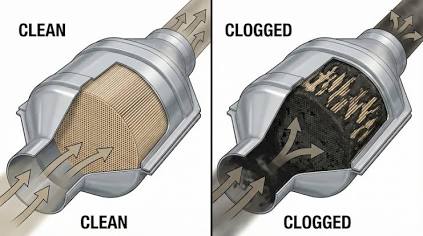
Every converter fault falls into one of two categories, and the distinction decides what happens next.
Chemical problems are contamination and deposits — a film of burnt oil or coolant coating the catalyst, or carbon build-up restricting flow. The honeycomb is intact; its surface is simply obstructed. These are frequently recoverable.
Structural problems are physical. Persistent misfires send unburnt fuel into the converter where it ignites, and the resulting heat can melt the substrate. Speed bumps, potholes and low ground clearance crack casings. Age eventually degrades the catalysts themselves. Once the honeycomb is melted, cracked or broken up, no treatment restores it — which is why a rattle from inside the unit is the one symptom that settles the question immediately.
The reason this matters commercially is that a fault code cannot tell the two apart. A catalyst efficiency code says the converter is underperforming; it does not say whether that is contamination or collapse. If a garage has quoted for replacement, the question worth asking is whether physical damage was confirmed or inferred from the code. Where the unit is contaminated rather than broken, catalytic converter cleaning can often recover it, and our diagnostics — backpressure testing and inlet-versus-outlet temperature comparison — establish which of the two you are dealing with before anything is spent.
Frequently asked questions
What temperature does a catalytic converter need to work?
Around 250–300°C, known as light-off temperature. Below that the catalytic reactions barely proceed, which is why converters are mounted close to the engine and why short journeys are hard on them.
What metals are inside a catalytic converter?
Platinum, palladium and rhodium, applied as a wash-coat over a ceramic or metallic honeycomb. They act as catalysts, enabling the reactions without being used up.
Why is it called a three-way catalytic converter?
Because it deals with all three regulated pollutants — carbon monoxide, unburnt hydrocarbons and nitrogen oxides — within one unit, running oxidation and reduction reactions at the same time.
Do diesel cars have catalytic converters?
Yes, in the form of a diesel oxidation catalyst (DOC). On later diesels it sits ahead of the diesel particulate filter and plays a direct role in helping it regenerate.
Can a catalytic converter clean itself on a long drive?
No. Unlike a DPF, it has no self-cleaning cycle. A long run brings it up to working temperature but does not remove deposits already on the catalyst.
Think yours is struggling?
We diagnose before we recommend. See symptoms, our testing method and what mobile and factory CAT cleaning involves, or call us with the registration and we will talk it through.
Call 0333 366 1404 or request a call-back.